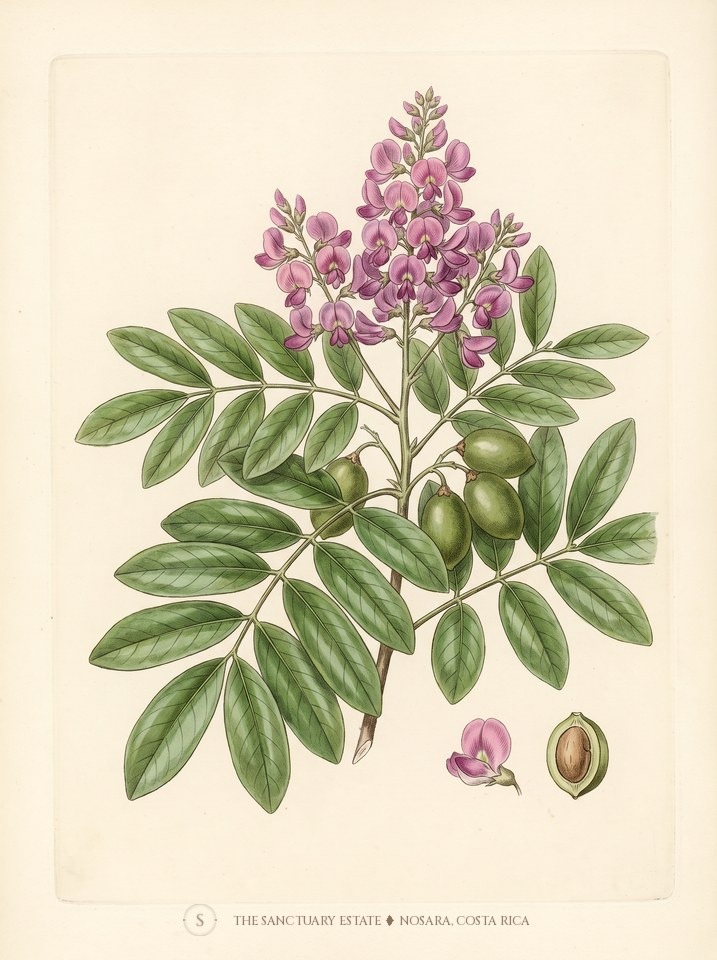
Hardwood · Flowering · Medicinal
Almendro de Montaña
Andira inermis (W.Wright) Kunth ex DC.
Tropical America and West Africa
Fun factFruit bats carry the fruits from the tree to feeding roosts and drop many on the way, scattering the seeds. Janzen and colleagues found that ripe fruits smell like slightly spoiled peaches, and that the smell carries at least 100 m downwind.
A medium to large evergreen tree of the legume family that grows in lowland forests from Mexico and the Caribbean into South America. In Guanacaste it is most common along watercourses, and many surviving trees now stand alone in pastures, fencerows and riverside strips. At the end of the dry season it bears big sprays of pink to purple pea-like flowers that bees visit, followed by green, single-seeded fruits that fruit bats eat and carry off.
Sourced · see Record tab
Wildacross the estate
FamilyFabaceae
Spanish nameAlmendro de montaña
Also known asCabbage bark, Cabbage angelin, Angelin, Bastard cabbage, Partridge wood
Native toNative from Florida and Mexico through Central America (including Costa Rica) and the Caribbean to Peru, Bolivia and Brazil, and, as Kew treats it, also across tropical West and Central Africa.
Grows wild across the estate.